Understanding Casino House Edge: Your Guide to Smarter Play
June 21, 2026 17 min read 3,417 words
Uncover the mathematical reality behind casino games to enhance your strategic approach and maximize your enjoyment.
Learn More Now
What is Casino House Edge and Why Does it Matter?
 Photo: Vanessa Garcia / Pexels
At the heart of every casino game lies a fundamental mathematical principle known as the 'house edge.' Far from being a nefarious plot, the house edge is simply the built-in mathematical advantage that the casino has over the player. It's how casinos ensure their profitability and, consequently, how they are able to offer entertainment, jobs, and grand facilities. Understanding casino house edge isn't just academic; it's absolutely crucial for anyone who wants to approach gambling with a realistic perspective and make informed decisions.
Imagine a coin flip where you bet on heads. The true odds are 50/50. If you bet $1 and win, you get $1 back. If you lose, you lose $1. In this scenario, there's no house edge. Now, imagine a casino offers you a game where you bet on a coin flip, but if you win, they only give you $0.95 back, and if you lose, you still lose $1. Over many flips, the casino would slowly but surely accumulate money. That difference between the true odds and the payout offered is the house edge.
Expressed as a percentage, the house edge represents the average percentage of every bet that the casino expects to keep over the long run. For instance, if a game has a 2% house edge, it means that for every $100 you wager, the casino statistically expects to keep $2. This doesn't mean you'll lose $2 for every $100 you bet in a single session; luck plays a significant role in the short term. You could win big, or you could lose quickly. However, over thousands, even millions, of bets across all players, the casino's profit will trend very closely to that calculated house edge.
Why does this matter to you as a player? Knowing the house edge helps you:
* **Set Realistic Expectations:** It disabuses you of the notion that you can consistently 'beat' the casino in the long run without employing specific, often advanced, strategies (like card counting in blackjack, which is highly scrutinized).
* **Choose Games Wisely:** Different games have vastly different house edges. A game with a 0.5% edge is significantly better for your bankroll than one with a 15% edge.
* **Manage Your Bankroll:** Understanding the edge helps you predict, to some extent, how quickly your money might deplete over a prolonged session.
* **Appreciate Strategy:** For games like blackjack or video poker, optimal strategy can significantly reduce the house edge, sometimes by several percentage points, turning a poor game into a manageable one.
In essence, the house edge is the casino's business model. It's the cost of entertainment. By understanding this fundamental concept, you transform from a naive gambler into an informed participant, better equipped to enjoy the experience without falling prey to common misconceptions about luck and probability. It empowers you to make smarter choices about where and how you play, ultimately extending your entertainment value. For more insights into responsible play, visit this resource on
responsible gambling.
Calculating and Interpreting the Casino's Advantage
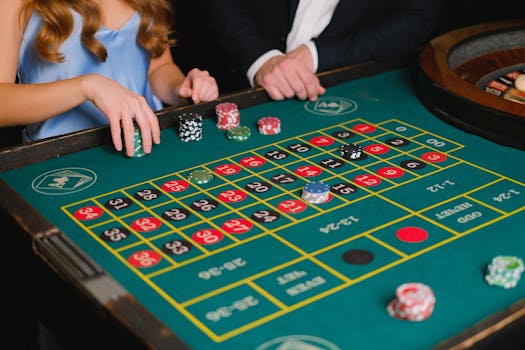 Photo: Anna Shvets / Pexels
While players rarely need to calculate the house edge themselves – these figures are widely published and analyzed by gambling experts – understanding its calculation provides valuable insight into how the casino maintains its advantage. The house edge is primarily derived from the disparity between the true odds of an event occurring and the payout odds offered by the casino for that event. Let's break down this concept with a simple example.
Consider a standard European Roulette wheel, which has 37 pockets: numbers 1 through 36, plus a single zero (0). If you bet on a single number, the true odds of that number hitting are 1 in 37. If the casino paid out at true odds for a single number bet, they would pay 36 to 1. This means if you bet $1 and won, you'd get your $1 back plus $36 profit. However, a casino typically pays 35 to 1 for a single number win. This difference is where the house edge comes from.
To calculate the house edge for a single number bet in European Roulette:
1. **Expected Loss per Bet:** If you bet $1 on a number, you have a 1/37 chance of winning $35 (profit) and a 36/37 chance of losing $1.
Expected Value (EV) = (Probability of Winning * Payout) - (Probability of Losing * Bet Amount)
EV = (1/37 * $35) - (36/37 * $1)
EV = $35/37 - $36/37
EV = -$1/37
2. **House Edge Percentage:** The expected loss per bet ($1/37, approximately -$0.027) is then divided by the initial bet amount ($1) and multiplied by 100 to get a percentage.
House Edge = (Expected Loss / Initial Bet) * 100
House Edge = ($1/37 / $1) * 100
House Edge ≈ 2.70%
This 2.70% is the house edge for European Roulette. It means, on average, for every $100 wagered on European Roulette, the casino expects to keep $2.70. For American Roulette, which has both a single zero (0) and a double zero (00), there are 38 pockets. The payout remains 35 to 1 for a single number. This changes the calculation significantly:
1. **Expected Loss per Bet (American Roulette):**
EV = (1/38 * $35) - (37/38 * $1)
EV = $35/38 - $37/38
EV = -$2/38 = -$1/19
2. **House Edge Percentage (American Roulette):**
House Edge = ($2/38 / $1) * 100
House Edge ≈ 5.26%
As you can see, the addition of just one extra pocket (the 00) nearly doubles the house edge, making American Roulette a significantly worse game for the player compared to its European counterpart. This stark difference highlights the importance of understanding these percentages. A higher house edge translates directly to a faster expected depletion of your bankroll over time. Interpreting these figures means recognizing that while small percentages might seem insignificant, they compound over many bets. Over hours of play and hundreds of wagers, even a 1% difference can amount to substantial sums for both the player (in losses) and the casino (in profits). It's the invisible cost of entertainment that every player should be aware of.
House Edge Across Popular Casino Games
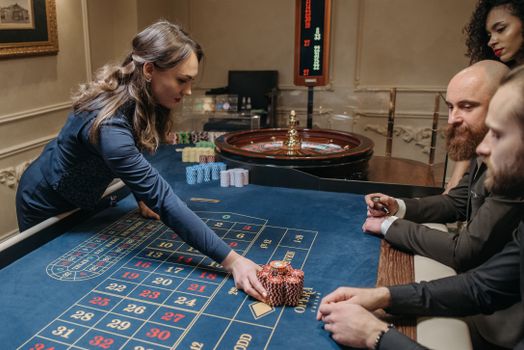 Photo: Pavel Danilyuk / Pexels
The house edge is not static across all casino games; it varies dramatically, making some games inherently more favorable to the player than others. Understanding these differences is paramount for strategic gambling. Here’s a breakdown of the typical house edge for some of the most popular casino games, along with factors that influence them:
* **Blackjack (0.5% - 2%):** Blackjack is often lauded as having one of the lowest house edges, especially when played with optimal basic strategy. The edge can be as low as 0.5% to 1% in many casinos. However, variations in rules (e.g., number of decks, dealer hits or stands on soft 17, blackjack payout ratios like 6:5 instead of 3:2) can significantly impact this. A 6:5 blackjack payout, for instance, can increase the house edge by over 1.4%, effectively doubling it in some cases. Knowing basic strategy is crucial here; without it, the edge can easily jump to 2% or more. Advanced techniques like card counting, while difficult and often discouraged by casinos, can even turn the edge in the player's favor, albeit temporarily and under very specific conditions.
* **Video Poker (0.5% - 5%):** Similar to blackjack, video poker offers a low house edge when played with optimal strategy and on machines with favorable pay tables. Games like 'Jacks or Better' or 'Deuces Wild' can have an edge under 1%, sometimes even approaching 0.2% or lower for 'full pay' machines. However, 'short pay' machines, which offer reduced payouts for certain hands, will significantly increase the house edge. Players must research pay tables and memorize optimal strategy charts to truly benefit from these games. Without strategy, the edge can easily soar above 3-5%.
* **Baccarat (1.06% - 1.24%):** Baccarat is a game of chance with a surprisingly low house edge, especially on the 'Banker' bet. The Banker bet typically has an edge of about 1.06%, while the 'Player' bet has an edge of around 1.24%. The 'Tie' bet, though tempting with its high payout (often 8:1 or 9:1), carries a much higher house edge, usually around 14.36%. For this reason, experienced baccarat players almost exclusively stick to the Banker or Player bets. The simplicity of the game, combined with its favorable odds, makes it popular among both high rollers and casual players.
* **Craps (0% - 1.41% on Pass/Don't Pass):** Craps is one of the most exciting casino games, and it offers some of the best odds if you stick to the right bets. The 'Pass Line' and 'Don't Pass Line' bets have a house edge of 1.41% and 1.36% respectively. The truly unique aspect of craps is the 'Odds Bet,' which has a 0% house edge. This bet is placed after a point is established and pays out at true odds. Players can 'take' or 'lay' odds on their Pass/Don't Pass bets, which effectively reduces the overall house edge of their total wager. Other bets on the craps table, such as 'Any 7' or 'Hardways,' can have house edges reaching 10% to 16%, making them extremely poor choices for the informed player. Prioritize understanding these bets through resources like this guide on
casino game strategies.
* **Roulette (2.70% European, 5.26% American):** As discussed, roulette's house edge depends entirely on the version played. European Roulette (single zero) has a 2.70% edge, while American Roulette (double zero) has a 5.26% edge. Always choose European Roulette if available. Some European rules, like 'La Partage' or 'En Prison' (where you get half your even-money bet back if 0 hits), can further reduce the edge on even-money bets to as low as 1.35%.
* **Slot Machines (2% - 15%+):** Slot machines generally have the highest house edge among casino games, and it's also the most opaque. The house edge (or 'Return to Player' - RTP, which is 100% minus the house edge) can range from around 2-3% on some high-denomination, high-RTP machines to over 15% on penny slots. Casinos are not required to publish the RTP for individual slot machines, though some jurisdictions mandate minimum RTPs. The general rule is that higher denomination slots often have better RTPs than lower denomination ones. Because of the sheer volume of spins possible, even a seemingly small edge can lead to significant losses over time. It's crucial for players to understand that slots are pure games of chance, and no skill or strategy can influence their outcome.
This overview illustrates that game choice is perhaps the single most impactful decision a player can make regarding the house edge. Opting for games with lower edges, and then employing optimal strategy where applicable, can significantly prolong playtime and improve the mathematical probability of a favorable short-term outcome.
Minimizing the House Edge: Smart Strategies and Pitfalls to Avoid
 Photo: Anna Shvets / Pexels
While you can never truly eliminate the casino house edge (unless you’re a professional card counter or advantage player, which is a different league entirely), you can absolutely minimize its impact and give yourself the best possible chance. This isn't about 'beating' the casino in the long run, but rather about playing smarter, extending your entertainment, and maximizing your potential for short-term wins. Here are some key strategies and common pitfalls to avoid.
**Strategies to Minimize House Edge:**
1. **Choose Games with Lower House Edge:** This is arguably the most critical strategy. As discussed, games like blackjack (with basic strategy), baccarat (on Banker bet), craps (on Pass/Don't Pass with odds), and full-pay video poker offer significantly better odds than slots, Keno, or American Roulette. Always prioritize these games if your goal is to maximize playtime and potential returns.
2. **Learn and Apply Optimal Strategy:** For skill-based games like blackjack and video poker, ignoring basic strategy is akin to donating money to the casino. Basic strategy charts for blackjack tell you the mathematically correct decision for every possible hand combination against the dealer's upcard. Similarly, video poker strategy charts guide you on which cards to hold. These strategies are derived from millions of simulated hands and are designed to reduce the house edge to its absolute minimum for that particular game variant. Practice these strategies online or with free apps before playing for real money.
3. **Take Advantage of 'Odds' Bets in Craps:** The 'Odds' bet in craps is unique because it has a 0% house edge. After making a Pass Line or Don't Pass Line bet, you can place an additional bet behind it, called the Odds bet. Casinos allow you to bet multiples of your initial wager (e.g., 2x, 3x-4x-5x, 10x, or even 100x odds). By taking maximum odds, you significantly dilute the overall house edge of your total wager, as a larger portion of your money is being bet at true odds.
4. **Understand and Utilize Rules Variations:** Small rule differences can have a big impact. For example, always prefer European Roulette over American Roulette. In blackjack, look for tables that pay 3:2 for blackjack (rather than 6:5), allow doubling down on any two cards, allow re-splitting aces, and have the dealer stand on soft 17. Each of these rules slightly reduces the house edge in your favor.
5. **Manage Your Bankroll Effectively:** While not directly reducing the house edge, proper bankroll management is crucial for surviving its long-term effects. Set a budget for each session and stick to it. Don't chase losses. Understanding that the house edge means you're expected to lose over time helps you accept losses as the cost of entertainment and prevents you from making rash decisions.
6. **Utilize Casino Loyalty Programs and Promotions:** While these don't change the mathematical edge of the game, they offer 'comps' (complimentaries) like free meals, hotel stays, or cashback. These can effectively return a small percentage of your theoretical losses, slightly offsetting the house edge. Always understand the terms and conditions of any bonus or promotion, especially wagering requirements, before accepting them.
**Pitfalls to Avoid:**
* **Chasing Progressive Jackpots Blindly:** While the allure of a massive jackpot is strong, many progressive slot machines or table games have a higher house edge on their base game to fund the jackpot. Only play them if the jackpot is so large that it theoretically makes the game positive expectation (a rare occurrence).
* **High House Edge Side Bets:** Many table games offer side bets (e.g., 'Perfect Pairs' in blackjack, 'Tie' in baccarat). These almost invariably carry a significantly higher house edge than the main game. Avoid them.
* **Betting Systems (e.g., Martingale):** No betting system can overcome the house edge. Systems like Martingale (doubling your bet after a loss) rely on infinite bankrolls and no table limits, which don't exist in reality. They can lead to rapid and catastrophic losses.
* **Playing While Intoxicated or Emotional:** Impaired judgment leads to poor decisions, often involving higher-risk bets or ignoring strategy, which effectively increases the house edge against you.
* **Believing in 'Hot' or 'Cold' Streaks:** While streaks occur due to random variance, past outcomes have no bearing on future probabilities in most casino games. Each spin of the roulette wheel or deal of cards is an independent event.
By diligently applying these strategies and steering clear of common pitfalls, you equip yourself to navigate the casino environment more effectively, ensuring that your gambling experience remains enjoyable and within your financial comfort zone.
