Understanding Casino House Edge: Your Guide to Smarter Play
June 19, 2026 17 min read 3,328 words
Unravel the mathematical advantage casinos hold and empower your gambling decisions with knowledge.
Boost Your Edge
What is the Casino House Edge and Why Does It Matter?
 Photo: Nancho / Pexels
In the exciting world of casino gaming, where flashing lights, thrilling sounds, and the promise of big wins captivate millions, there's a fundamental concept that every player, from novice to veteran, must grasp: the casino house edge. Far from being a mysterious trick, the house edge is a transparent, mathematical advantage that casinos build into every game they offer. It's not about cheating; it's about business. Understanding casino house edge is paramount because it directly impacts your long-term prospects at the tables and slots. Without this knowledge, players often operate under misconceptions, leading to frustration and potentially significant losses.
At its core, the house edge is the average percentage of every bet that a casino expects to keep as profit over the long run. Let's break that down. Imagine you bet $100 on a game with a 2% house edge. In theory, for every $100 you wager, the casino expects to keep $2. This isn't to say you'll lose exactly $2 on every $100 bet; gambling is inherently volatile, and short-term results can vary wildly. You might win big, you might lose everything, but over an infinite number of bets, the casino's 2% will invariably manifest. This edge is what allows casinos to build their opulent resorts, pay their staff, and remain profitable enterprises. It's the cost of admission, the built-in fee for the entertainment and the chance to win.
Why does this matter to you, the player? Because it informs your game selection, your betting strategy, and your overall approach to gambling. Games with a lower house edge offer better theoretical returns to the player (RTP) and thus, a better chance of extending your playtime or even walking away with a profit in the short term. Conversely, games with a high house edge are designed to deplete your bankroll more quickly. Ignoring the house edge is akin to playing a sport without knowing the rules – you might participate, but you're unlikely to excel. It transforms gambling from a hopeful punt into a more strategic endeavor. For those looking to improve their odds and make more informed decisions, learning about the house edge is the first crucial step. It helps set realistic expectations and encourages responsible gaming habits. Knowing the house edge empowers you to make choices that align with your entertainment goals and bankroll management. For more insights on responsible gaming, check out this guide on
responsible gambling practices.
Furthermore, the house edge isn't a static number across all casino games. It varies significantly from one game to another, and even within the same game, it can change based on the specific rules or the type of bet you place. For instance, a single-zero roulette wheel has a lower house edge than a double-zero wheel. In blackjack, the house edge can fluctuate based on the specific rules of the table and, crucially, the player's strategy. A player employing basic strategy in blackjack can significantly reduce the house's advantage compared to someone playing intuitively. This variability highlights the importance of not just knowing that a house edge exists, but also understanding its specific application to the games you choose to play. This foundational knowledge is the cornerstone of intelligent casino play, shifting the paradigm from pure luck to a blend of chance and informed decision-making.
Deconstructing the Math: How House Edge is Calculated
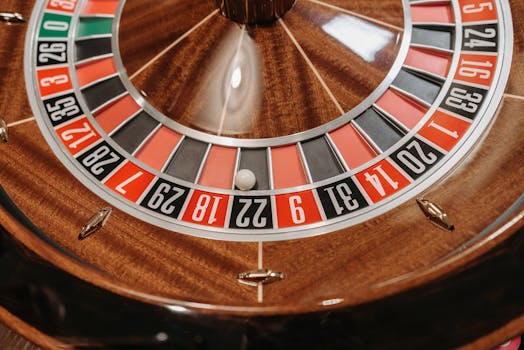 Photo: Pavel Danilyuk / Pexels
To truly appreciate the impact of the house edge, it's beneficial to delve into its mathematical underpinnings. While you don't need to be a mathematician to gamble, understanding the calculation provides a clearer picture of how casinos maintain their advantage. The house edge is essentially the difference between the true odds of an event occurring and the payout odds offered by the casino, expressed as a percentage. Let's use a classic example: roulette.
Consider a European roulette wheel, which has 37 pockets: numbers 1-36 and a single zero (0). If you bet on a single number, the true odds of that number hitting are 1 in 37. If the casino paid out at true odds, a winning single-number bet would pay 36 times your stake (you get your original stake back plus 35 units). However, casinos typically pay 35 to 1. This subtle difference is where the house edge resides.
Let's calculate the house edge for a single number bet in European roulette: If you bet $1 on each of the 37 numbers, you would spend $37. One of your numbers would win, paying you $36 (your $1 bet back plus $35 profit). Your net loss would be $1 ($37 spent - $36 returned). The house edge is calculated as (Net Loss / Total Wagers) * 100%. So, ($1 / $37) * 100% ≈ 2.70%. This 2.70% is the house edge for European roulette. This means that, on average, for every $100 wagered on European roulette, the casino expects to keep $2.70.
Now, let's look at American roulette, which adds a double zero (00) pocket, bringing the total to 38 pockets (1-36, 0, 00). The true odds of a single number hitting become 1 in 38. Yet, the casino still pays 35 to 1. Using the same calculation: if you bet $1 on each of the 38 numbers, you spend $38. One number wins, paying $36. Your net loss is $2 ($38 spent - $36 returned). The house edge is ($2 / $38) * 100% ≈ 5.26%. Notice how the addition of just one extra pocket (the double zero) nearly doubles the house edge, significantly reducing your long-term return. This stark difference between European and American roulette beautifully illustrates the power of a seemingly small mathematical adjustment.
This principle applies to all casino games, though the calculations can become more complex for games like blackjack or video poker, where player decisions influence the outcome. In these games, the stated house edge often assumes optimal play (e.g., using basic strategy in blackjack). Any deviation from optimal strategy will increase the effective house edge against the player. For slot machines, the house edge is determined by the game's programming, specifically its Return to Player (RTP) percentage. An RTP of 96% means the house edge is 4%. This figure represents the average percentage of wagered money that a slot machine pays back to players over a very long period. Understanding these calculations helps demystify the casino's profitability and equips players with the knowledge to make smarter game choices.
You may also find Adultwork Glasgow useful.
Navigating the Casino Floor: House Edge by Game Type
 Photo: Pavel Danilyuk / Pexels
Not all casino games are created equal when it comes to the house edge. This variability is a critical piece of information for any player looking to optimize their gaming experience. By understanding the typical house edge percentages across different game types, you can make more informed decisions about where to place your bets and potentially extend your playtime. Let's explore some popular casino games and their approximate house edges.
**Blackjack:** Often touted as one of the best games for players, blackjack typically has one of the lowest house edges, especially when played with optimal strategy (basic strategy). Depending on the specific rules (number of decks, dealer hits or stands on soft 17, surrender options, etc.), the house edge can range from as low as 0.5% to 2%. A player who consistently uses basic strategy can significantly reduce the casino's advantage, making it a favorite for strategic players. Deviating from basic strategy, however, can quickly inflate this edge.
**Video Poker:** Similar to blackjack, video poker offers some of the best odds in the casino, again, contingent on optimal play. Different video poker variations have different pay tables, and it's these pay tables that dictate the house edge. For example, a 'Full Pay' Jacks or Better game might have an RTP of 99.54%, meaning a house edge of just 0.46% with perfect strategy. Other variations, like Deuces Wild, can even offer a theoretical RTP over 100% with certain pay tables and expert play, though these are rare to find in brick-and-mortar casinos. The key here is knowing the specific pay table and employing the correct strategy.
**Craps:** This fast-paced dice game offers a variety of bets, each with its own house edge. The 'Pass Line' and 'Don't Pass Line' bets, especially when combined with 'Odds' bets (which have no house edge), offer some of the best odds in the casino, typically around 1.4% for Pass/Don't Pass. Other bets on the craps table, such as proposition bets (e.g., 'Any Seven'), can have a house edge as high as 16.67%, making them very poor choices for the savvy player. Understanding which craps bets to make and which to avoid is crucial.
**Baccarat:** Baccarat is another game with a relatively low house edge, making it popular among high rollers. The 'Banker' bet has a house edge of approximately 1.06% (after the 5% commission), the 'Player' bet has an edge of about 1.24%, and the 'Tie' bet, while offering a much higher payout, carries a significantly larger house edge of around 14.36%. For the best odds, players are advised to stick to the Banker bet.
**Roulette:** As discussed, the house edge in roulette depends on the wheel type. European roulette (single zero) has a house edge of 2.70%. American roulette (double zero) has a house edge of 5.26%. Some European roulette rules, like 'En Prison' or 'La Partage,' can even reduce the edge on even-money bets further, sometimes to as low as 1.35%. Always opt for European roulette if available. For those interested in improving their overall
gambling skills, understanding these nuances is essential.
**Slot Machines:** Slot machines generally have a higher house edge compared to table games, often ranging from 2% to 15% or even higher, depending on the machine and the casino. The exact RTP (and thus house edge) is usually programmed into the machine and can vary significantly. While some online slots might advertise RTPs of 97-98%, physical slot machines typically offer less favorable returns. Due to their random nature and lack of player strategy, slots are often considered games of pure chance, where the house edge plays a more direct role in long-term outcomes.
By being aware of these differences, players can make more strategic choices, favoring games and bets with lower house edges to maximize their potential for entertainment and winning. It's a fundamental aspect of informed gambling that separates casual play from strategic engagement.
Strategies to Mitigate the House Edge and Play Smarter
Photo: Nancho / Pexels
While the house edge is an inherent and unavoidable aspect of casino gambling, understanding it is the first step towards smarter play. The next step is to adopt strategies that can effectively mitigate its impact, extending your playtime, preserving your bankroll, and improving your overall experience. Here are some actionable tips:
* **Choose Games with Lower House Edges:** As detailed in the previous section, some games inherently offer better odds than others. Prioritize games like blackjack (with basic strategy), video poker (with optimal strategy and good pay tables), and baccarat (betting on the Banker). Avoid high-edge bets within games, such as proposition bets in craps or the 'Tie' bet in baccarat.
* **Master Basic Strategy (for applicable games):** For games like blackjack and video poker, employing basic strategy is not optional; it's essential. Basic strategy charts are mathematically derived to tell you the optimal play for every possible hand combination. Memorizing and consistently applying these strategies can reduce the house edge to its absolute minimum, often below 1%. Playing without basic strategy can easily double or triple the house's advantage against you.
* **Understand and Utilize Odds Bets in Craps:** In craps, after placing a 'Pass Line' or 'Don't Pass Line' bet, you have the option to place an 'Odds' bet. Crucially, the 'Odds' bet has a 0% house edge, making it the fairest bet in the casino. While you must first place a Pass/Don't Pass bet (which has a house edge), maximizing your Odds bet effectively dilutes the overall house edge of your total wager. Always take full odds if your bankroll allows.
* **Seek Out Favorable Rules:** Even within the same game, rules can vary between casinos and even between tables. For example, in blackjack, look for tables that pay 3:2 for a blackjack instead of 6:5, allow late surrender, or where the dealer stands on soft 17. In roulette, always choose European (single zero) over American (double zero) wheels. These seemingly small rule variations can have a significant impact on the house edge.
* **Manage Your Bankroll Effectively:** While not directly affecting the house edge, responsible bankroll management is critical for making your gambling funds last longer. Set a budget before you start playing and stick to it. Avoid chasing losses, as this often leads to making irrational decisions and placing high-edge bets out of desperation.
* **Utilize Casino Loyalty Programs and Comps:** Casinos often reward loyal players with comps (complimentary services) and points that can be redeemed for cash or other perks. While these don't reduce the house edge of individual bets, they can effectively return a small percentage of your theoretical losses, thus improving your overall expected return from the casino experience. It's like getting a small rebate on your entertainment cost.
* **Avoid Side Bets and Progressive Jackpots (with caution):** Many table games offer enticing side bets with large payouts. However, these side bets almost always come with a significantly higher house edge than the main game. Similarly, while progressive jackpots offer life-changing sums, the portion of your bet that contributes to the jackpot often carries a very high theoretical house edge, making them poor value bets unless the jackpot reaches an exceptionally high level. Play these for the thrill, but be aware of the cost.
By combining knowledge of the house edge with disciplined strategy and responsible bankroll management, players can transform their casino visits into more informed, enjoyable, and potentially more rewarding experiences. Remember, the goal is not necessarily to beat the house consistently – that's mathematically improbable over the long run – but to minimize its advantage and maximize your entertainment value.
